Gravel roads are essential infrastructure for rural communities, farms, private properties, and many municipalities. Yet one of the most persistent and frustrating problems they face is washboarding those rhythmic ridges that make driving uncomfortable, unsafe, and costly to maintain. Understanding what causes washboard on gravel roads is the first and most critical step toward preventing it long-term rather than repeatedly fixing the surface only to see the problem return.
This guide is written to be the most complete, authoritative explanation available, combining road engineering principles, real-world maintenance practices, and clear, practical insight for property owners, contractors, and public works professionals.
Short Answer: What Causes Washboard on Gravel Roads?
Washboard on gravel roads is caused by repeated vehicle forces acting on loose, poorly bound aggregate. The primary contributors are frequent acceleration and braking, excessive traffic speed, improper gravel gradation, moisture imbalance, and maintenance practices that disturb the surface without correcting deeper structural issues.
When tires repeatedly bounce and push loose gravel forward, small ripples begin to form. Over time, these ripples harden into evenly spaced corrugations. Once washboard starts, traffic reinforces it daily, especially on dry roads with insufficient fines to bind the surface together.
In short, washboard is not caused by one single issue, but by a combination of traffic behavior, material quality, moisture conditions, and maintenance timing.
Understanding Washboard (Corrugation) on Gravel Roads
What Is Washboard on Gravel Roads?
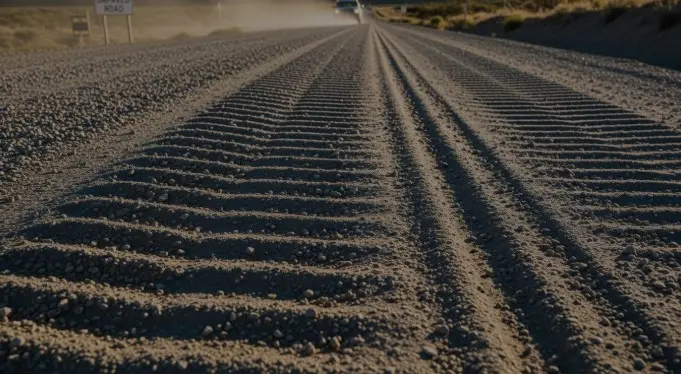
Washboarding, also called corrugation, is a repeating pattern of ridges and valleys that form perpendicular to the direction of travel. These ridges feel like driving over a washboard or rumble strip.
Washboard is more common on unpaved roads because gravel lacks the rigid binding properties of asphalt or concrete. Without proper fines, moisture, and compaction, the surface remains mobile and vulnerable to repeated stress.
How Washboard Forms Over Time
Washboard develops gradually. Vehicle tires apply uneven forces to loose gravel, causing particles to migrate forward. Tire bounce, suspension vibration, and surface dryness amplify this movement. Once ripples form, they create a feedback loop: each ridge causes more bouncing, which deepens the next ridge.
Without intervention at the root cause, washboard worsens rapidly.
What Causes Washboard on Gravel Roads?
Traffic Speed and Acceleration Forces
High-speed traffic is one of the strongest contributors to washboard. Faster vehicles generate greater tire bounce and suspension oscillation, which pushes gravel forward unevenly.
Rapid acceleration and braking intensify surface displacement
Light vehicles often cause more vibration than heavy trucks
Downhill sections and intersections are especially vulnerable
Improper Gravel Gradation
Gravel roads require a mix of stone sizes, including fines (stone dust), to lock particles together.
Too little fines = loose, unstable surface
Rounded gravel rolls instead of interlocking
Poor gradation prevents proper compaction
Even frequent grading cannot compensate for the wrong gravel mix.
Moisture Imbalance in the Road Surface
Moisture acts as a natural binder.
Too dry: dust loss removes binding material
Too wet: saturated gravel loses strength
Summer washboarding is common because evaporation dries out fines, leaving larger stones loose and mobile.
Inadequate Road Base or Subgrade
A weak base allows surface movement no matter how well the top layer is maintained.
Thin or poorly compacted base amplifies vibration
Surface-only fixes fail when the foundation is weak
True washboard prevention starts below the surface.
Maintenance Errors That Make Washboard Worse
Well-intended maintenance can accelerate washboard if done incorrectly.
Grading during dry conditions loosens gravel
Blading without adding new material removes fines
Repeated smoothing polishes stone, reducing interlock
The Physics Behind What Causes Washboard on Gravel Roads
Vibration Theory Explained Simply
As vehicles move, tires bounce slightly. When bounce frequency matches the natural resonance of the gravel surface, ripples form. Each ripple causes more bounce, reinforcing the pattern.
Granular Flow and Particle Migration
Gravel behaves like a fluid under repeated load. Particles migrate forward, spacing themselves evenly based on vehicle speed, tire size, and surface stiffness. This is why washboard patterns are often uniform.
People Also Ask: Related Questions About Washboard Roads
Why do gravel roads get washboarded so quickly?
Can washboard form even on new gravel roads?
Why does washboard come back after grading?
Is washboard caused more by cars or trucks?
Does speeding really cause washboard roads?
How Washboard Forms on a Gravel Road
Vehicles apply uneven force to loose gravel
Gravel migrates forward under tire pressure
Small ripples develop due to vibration
Moisture loss reduces surface binding
Ripples harden into corrugation
Daily traffic reinforces the pattern
Factors That Cause Washboard vs Their Impact
| Cause Factor | Severity Level | How Fast It Forms | Long-Term Damage |
|---|---|---|---|
| High speed traffic | High | Very fast | Severe |
| Poor gravel mix | High | Fast | Severe |
| Low moisture | Medium | Moderate | Medium |
| Improper grading | High | Fast | Severe |
| Weak road base | High | Slow | Critical |
How Different Gravel Types Affect Washboarding
Rounded Gravel vs Angular Gravel
Angular gravel interlocks better and resists movement, while rounded gravel rolls easily and promotes washboard.
Gravel With Fines vs Clean Stone
Fines bind the surface. Clean stone lacks cohesion and washboards quickly.
Recycled Road Base vs Virgin Aggregate
Recycled material can perform well if properly graded but varies widely in quality.
How to Prevent Washboard on Gravel Roads (Overview)
Design-Level Prevention
Maintain proper crown and drainage
Build sufficient base thickness
Material-Level Prevention
Use well-graded gravel with fines
Avoid uniform stone sizes
Traffic-Level Prevention
Enforce speed limits
Use signage and traffic calming where needed
Common Myths About What Causes Washboard on Gravel Roads
“Grading more often fixes it” – It often makes it worse
“Heavier gravel prevents washboard” – Weight alone doesn’t bind material
“Only speeding causes washboard” – Speed is one factor, not the only one
FAQs: What Causes Washboard on Gravel Roads?
What causes washboard on gravel roads the most?
Excessive speed combined with poor gravel gradation and low moisture.
Does grading cause washboard?
Improper or poorly timed grading can worsen it.
Can washboard be permanently fixed?
Yes, but only by addressing base, material, moisture, and traffic factors together.
How often should gravel roads be maintained?
Based on traffic volume, weather, and material quality, not a fixed schedule.
Does rain help or worsen washboard?
Light moisture helps; heavy rain damages weak roads.
What gravel size is best to prevent washboard?
A well-graded mix with fines and angular stone.
Why does washboard always return?
Because the root cause was never corrected.
Are washboard roads dangerous?
Yes, especially for motorcycles, emergency vehicles, and high-speed traffic.
Conclusion: Understanding What Causes Washboard on Gravel Roads
Washboarding is not a mystery or an unavoidable nuisance. It is the predictable result of traffic forces acting on loose, poorly bound gravel under the wrong moisture and maintenance conditions. By understanding what causes washboard on gravel roads, road owners and managers can move beyond temporary fixes and implement strategies that reduce long-term costs, improve safety, and extend road life. For more information visit Dirt Road Repairs.
True prevention comes from better design, better materials, smarter maintenance, and controlled traffic behavior not just more grading.