
Where Did My $2,000 of Rock Go?
It is the most common complaint we hear from rural homeowners in North Georgia: I just put fresh gravel on this driveway last year, and now it looks like bare dirt again. Did the rain wash it all away?
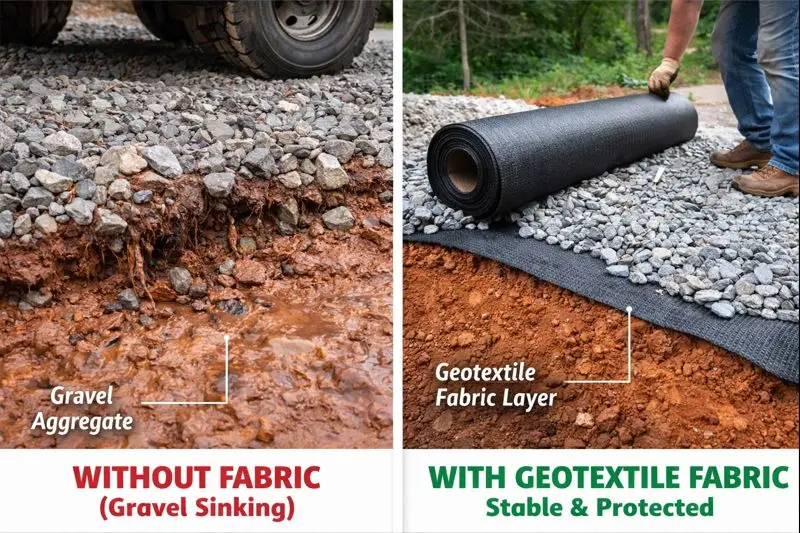
The answer is almost always no. Unless you see a pile of rocks at the bottom of the hill or in the ditch, your gravel didn’t wash away. It sank.
You are likely a victim of a geological process called Mud Pumping. Without the right foundation, you are essentially feeding expensive stone to the hungry Georgia red clay.
If you are tired of buying new gravel every two years only to see it vanish, the solution isn’t more rock. The solution is a structural separator. In this guide, we explain why Geotextile Fabric is the secret weapon for a driveway that lasts decades, not just seasons.
The Physics of Failure: Why Rock Sinks
To understand why your driveway failed, you have to understand what happens underground when it rains.
Imagine placing a heavy brick on top of a bowl of chocolate pudding. If you push down on the brick, what happens? The brick sinks to the bottom, and the pudding oozes up around the sides.
This is exactly what happens to your driveway:
- The Softening: Heavy rains turn the clay soil underneath your driveway into a soft, wet sludge (sub-grade).
- The Pressure: You drive your 4,000-lb vehicle over the driveway.
- The Mix: The weight pushes your clean #57 Stone down into the wet clay. Simultaneously, the hydraulic pressure pumps the mud up into the gravel voids.
Within a few months, your clean layer of stone is contaminated with mud. It loses its friction, it loses its drainage ability, and your driveway turns back into a slippery mud pit.
What is Geotextile Fabric? (Important Clarification)
- Before you run to the hardware store, we need to clarify a massive misconception.When we suggest “installing fabric,” many homeowners think of the thin, black “weed barrier” cloth you buy in the gardening section of Home Depot. This is NOT that.
At Dirt Road Repairs, we use Industrial-Grade Geotextile Stabilization Fabric.
- It is tough: You cannot tear it by hand. It is designed to sit under highways and retaining walls.
- It is permeable: It allows water to drain through it, but it does not allow solid particles (mud) to pass.
- It is permanent: Once buried, it does not rot or decay.
The 3 Main Benefits of Fabric
Why do we recommend this extra step? Because it performs three critical functions that gravel alone cannot do.
Separation (The Shield)
The primary job of this fabric is to act as a permanent shield between your Sub-base (the dirt) and your Aggregate (the gravel).
- Without Fabric: The rock and dirt mix together, creating a weak “soup.”
- With Fabric: The rock stays 100% clean on top. The dirt stays 100% separate on the bottom. As long as your gravel remains clean, it locks together and creates a hard, durable driving surface.
- Reinforcement (The Snowshoe Effect)
Think about walking in deep snow. If you wear boots, you sink. If you wear snowshoes, you stay on top. Why? Because the snowshoe spreads your weight over a larger area. Geotextile fabric does the same thing for your car. It has high tensile strength. When your tires push down, the fabric tightens and distributes that weight across the entire road width, preventing deep ruts from forming in the tire tracks.
Filtration
Water needs to go down, but mud shouldn’t come up. The fabric allows rainwater to drain through into the soil, keeping your gravel dry, but it blocks the wet clay from rising up to ruin the road.
The Financial Case: Pay Once or Pay Forever?
We understand that adding fabric increases the upfront cost of your driveway installation. You have to pay for the material and the labor to install it. But let’s look at the long-term math.
Scenario A: The Cheaper Option (No Fabric)
- Year 1: You pay for gravel.
- Year 2: The rock sinks. You pay for a “top dress” load.
- Year 4: The rock sinks again. You pay for another load.
- Result: You are on a permanent payment plan, buying rock forever.
Scenario B: The “Smart” Option (With Fabric)
- Year 1: You pay for gravel + fabric installation.
- Year 2: The rock is still sitting on top of the fabric.
- Year 5: The rock is still clean and draining well.
- Year 10: You might need a small touch-up, but the base is solid.
- Result: The fabric pays for itself by saving you 3 or 4 loads of gravel over the life of the driveway.
It is an investment, not an expense.
When is Fabric Absolutely Mandatory?
While every gravel driveway benefits from fabric, certain situations require it. If your property fits these descriptions, do not skip this step:
- New Construction: If you are cutting a driveway through raw forest or pasture, the soil is fresh, soft, and uncompacted. Fabric is essential to build a base.
- Wet Areas & Springs: If your driveway crosses a low-lying area that stays soggy after rain, gravel alone will never work. You need fabric to “bridge” the soft spot.
- Heavy Loads: If you own RVs, horse trailers, or heavy work trucks, the fabric acts as a reinforcement layer to prevent your heavy tires from digging ruts immediately.
Conclusion: Build It Right, Build It Once
If you are tired of watching your hard-earned money sink into the ground, stop buying more rocks. Fix the foundation first.
At Dirt Road Repairs, we don’t just dump gravel; we build road systems. By grading the land, installing Geotextile Fabric, and then spreading the stone, we ensure your driveway stays on top of the soil where it belongs.
Ready to fix it for good? Contact us today for an estimate on Stabilization Fabric installation. We can assess your soil and tell you exactly what your road needs.
📞 Call: 770-771-3977 📅 Schedule Online: Contact Us