This isn’t about buying more rocks. It’s a decision framework for stopping erosion permanently.
Introduction: Why Some Gravel Driveways Last 20 Years
You’ve seen it before: The neighbor’s driveway that sits perfectly flat and stable for decades, while yours turns into a jagged creek bed after every heavy rain.
It’s the same gravel. It’s the same rain. So, why is the result so different?
The difference isn’t luck. It’s physics.
Gravel failure is predictable. If you understand the conditions causing the failure, you can stop it permanently. If you ignore them, you are just renting your gravel until the next storm takes it back to the woods.
This guide is not a list of quick tips. It is a decision framework to help you identify exactly why your driveway is failing and how to engineer a solution that lasts.
First: Identify WHAT Changed?
Gravel washouts rarely happen just because. Usually, a variable on your property has changed. Before you order another load of stone, ask yourself:
- Has the weather shifted? We are seeing more intense, concentrated bursts of rain in Georgia than in previous decades.
- Did a neighbor clear land upstream? If the property above you cut down trees, your driveway is now handling their runoff too.
- Did you upgrade your vehicle? Moving from a sedan to a heavy truck or trailer changes the stress load on the rock.
- Are your ditches full? Over time, leaves and sediment fill ditches, forcing water back onto the road surface.
The Reality: You cannot fix a problem if you are solving for the conditions of ten years ago. You must solve for today’s water load.
The Two Ways Gravel Fails (Different Fixes Required)
Most homeowners treat all driveway problems the same. But in reality, gravel fails in two distinct ways:
Type A: Surface Washout (The Migration)
- Symptoms: Deep ruts running down the hill; gravel piling up at the bottom of the driveway.
- Cause: Water velocity. The water is moving faster than the rock can hold its ground.
- The Fix: You need to manage Flow & Shape.
Type B: Sub-Base Failure (The Sinking)
- Symptoms: Gravel disappears but there is no pile at the bottom; ruts are filled with mud; the road feels squishy.
- Cause: Soft clay sub-soil. The rock is being swallowed by the earth.
- The Fix: You need Separation & Stabilization (Geotextile).
Key Rule: If you try to fix a sinking road with washout tactics (or vice versa), the problem will return within months.
Step 1: Shape the Road for the WORST Storm
A flat driveway is a dead driveway. To survive a Georgia thunderstorm, your road needs a Crown.
The Logic: Water takes the path of least resistance. If your road is flat, the water flows down the length of the driveway, gaining speed and power with every foot. By building a crown (making the center higher than the edges), we force water to drain sideways immediately.
Real World Adjustments:
- Steep Slopes: Require a higher crown (up to 6%) to shed water faster.
- Clay Soil: Zero forgiveness. Any flat spot will become a pothole.
- Avoid Borders: Never use railroad ties or wood borders on a long driveway. They trap water on the road, turning it into a canal.
Step 2: Choose Gravel Based on SLOPE, Not Looks
The biggest mistake DIYers make is choosing gravel because it looks nice.
The Physics of Friction:
- Round Rock (Pea Gravel/River Rock): Acts like marbles. On a slope, gravity will always win. Never use this on a driveway.
- Angular Rock (#57 Stone / Crusher Run): Has sharp, jagged edges. When compacted, these edges lock together like puzzle pieces.
Conditional Logic:
- Flat Driveway: You can get away with cleaner stone (#57).
- Steep Slope: You need Crusher Run (stone mixed with dust) to create a concrete like bond.
- Heavy Loads: The base layer matters more than the top layer. You may need larger #4 stone underneath for support.
Step 3: Compaction Requirements Change With Traffic
Simply spreading gravel with a tailgate or a box blade is not enough. Loose gravel moves. Compacted gravel stays.
The Traffic Factor:
- Light Traffic (Cars): Rain and time will eventually settle the stone, but you will lose gravel in the process.
- Heavy Traffic (Trucks/Trailers): Heavy tires push loose stone aside instantly. You must mechanically compact the road.
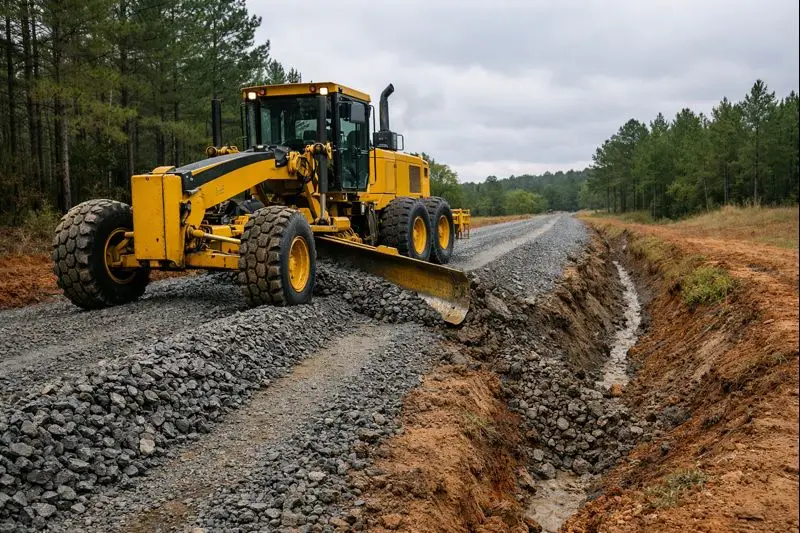
At Dirt Road Repairs, we use a Vibratory Roller. This machine shakes the ground while pressing down, locking the stones together so tightly that surface water flows over them rather than through them. Hand tamping is useless on a driveway scale.
Step 4: Water Needs an EXIT (Design by Length)
Once the crown pushes water off the road, where does it go?
The Exit Strategy depends on length:
- Short Driveway (<100 ft): A simple ditch on the side is usually sufficient.
- Long Driveway (>300 ft): A ditch isn’t enough. As water travels down a long ditch, it gains speed and volume. You need Turnouts (Tail Ditches).
- Steep Slope: You need frequent turnouts (every 50 75 feet) to eject water into the woods before it becomes a raging river.
Key Rule: Water that can’t escape will eventually destroy whatever it touches.
Step 5: Velocity Control (When Ditches Become Rivers)
If your driveway is steep, the water in your ditch can move fast enough to eat away the soil bank (scouring). This eventually undermines your driveway’s edge.
The Solution: Check Dams We install large “Surge Stone” or Rip Rap at intervals in the ditch. These act as speed bumps for the water.
- Low Velocity: Water flows gently.
- High Velocity: Water hits the rocks, slows down, and loses its destructive energy.
When Gravel Is NOT Washing Away It’s Being EATEN
Remember Type B Failure? If you keep adding gravel but the road stays muddy, your driveway is being eaten from below.
The Condition: Soft, wet clay sub-soil (Mud Pumping). The Fix: Geotextile Fabric.
By installing a woven fabric layer between the dirt and the rock, you prevent the gravel from sinking. No amount of surface grading will fix a sub-base problem. If your road is mushy, stop buying gravel and start looking at stabilization.
Why Product Based Fixes (Plastic Grids) Fail
You will see ads for Plastic Paver Grids or Driveway Borders that promise a quick fix.
Why they fail on rural driveways:
- Cost: Gridding a 500ft driveway is astronomically expensive compared to proper grading.
- Trapped Water: Borders and grids often prevent water from shedding off the road naturally.
- Maintenance: You cannot grade a driveway with a scraper blade if it is full of plastic. Once it clogs with mud, it is ruined.
These products are designed for small, flat city parking pads not rural Georgia roads.
What a REAL Fix Looks Like (System Thinking)
A stable driveway isn’t a product; it’s a system.
- Structure: A solid sub-base (Fabric if needed).
- Shape: A high crown to shed water.
- Drainage: Deep ditches and turnouts to remove water.
- Lock: Compaction to hold it all together.
Gravel driveways don’t fail because of missing gadgets they fail because of missing systems.
Cost Reality: What Changes the Price?
We believe in transparency. The cost to fix your washout depends on:
- Length & Slope: Steeper/Longer = More water management (Turnouts/Check Dams).
- Soil Condition: Soft clay requires Geotextile Fabric (higher material cost).
- Access: Can we get heavy equipment in?
The ROI: Fixing the drainage once is cheaper than replacing the gravel every single year.
Quick Diagnosis Guide
- Gravel is gone, but no pile at the bottom? -> Sinking (Sub-base failure).
- Deep ruts after a storm? -> Surface Washout (Crown failure).
- Mushy feel weeks after rain? -> Trapped Groundwater (Needs French Drain).
- Ditch is deeper than before? -> Velocity Issue (Needs Check Dams).
Conclusion
Every driveway is different. The solution that works for your neighbor’s flat road will fail on your hillside. Stop treating the symptom (holes) and start fixing the condition (water flow).
Professional Diagnosis Beats Trial & Error
We don’t just sell gravel. We diagnose why your road is failing and we fix that.
Stop the washout cycle. 📞 Call Dirt Road Repairs: 770-771-3977 📅 Schedule an On-Site Evaluation