Gravel driveways provide an affordable and attractive surface for rural and suburban properties, but they are vulnerable to erosion from concentrated water flow. Downspouts that discharge onto or near gravel driveways cause washouts, ruts, and material loss that require frequent repairs. Redirecting gutter water away from gravel surfaces prevents this damage and reduces long-term maintenance.
Why Gravel Driveways Erode
Gravel driveways consist of loose stones that rely on compaction and confinement to stay in place. Water flowing across the surface picks up individual stones and carries them along. The moving water also washes out fine material that fills gaps between larger stones and helps lock them together.
A single downspout can discharge 400 to 600 gallons during a one-inch rainfall. This concentrated flow has enough force to move gravel and cut channels into the surface. Each storm deepens the channels and widens the eroded area.
The damage compounds over time. Eroded areas collect more water during future storms, increasing the erosion rate. Gravel that washes away must be replaced. Without addressing the water source, replacement gravel erodes just as quickly as the original material.
Extending Downspouts Beyond the Driveway
The simplest solution moves the discharge point away from the gravel surface entirely.
Above-Ground Extensions
Flexible downspout extensions attach to the bottom elbow and carry water several feet from the downspout location. These extensions can route around the driveway edge to discharge onto lawn, landscaping, or other areas that tolerate water better than gravel.
Rigid extensions provide a more permanent solution. Solid pipe sections carry water further than flexible extensions and resist damage from mowers, foot traffic, and UV exposure.
Position the discharge end at least three feet beyond the driveway edge, and further if the ground slopes back toward the gravel. The goal is to release water where it can spread out and soak in rather than flowing across the driveway.
Buried Pipe Systems
Underground pipes carry water beneath the driveway to discharge on the opposite side. This approach works when the downspout is on the wrong side of a driveway or when surface extensions would cross traffic areas.
Dig a trench from the downspout location, under the driveway, to a discharge point on the other side. Use solid-wall pipe for the underground run to prevent water from escaping beneath the driveway and undermining the gravel. Maintain at least a one percent slope for drainage.
The pipe can terminate at a pop-up emitter, splash block, or open discharge in a suitable area. Choose a location where the water can disperse without causing erosion.
Dry Wells & Infiltration Systems
When suitable discharge locations are not available, dry wells collect water and allow it to soak into the ground.
Basic Dry Well Construction
A dry well is an underground chamber surrounded by gravel that stores water temporarily and releases it slowly into the surrounding soil. The chamber can be a large plastic barrel with holes drilled in the sides, a purpose-built plastic infiltration unit, or a pit filled entirely with large gravel.
Dig a hole at least three feet deep and three feet in diameter, located away from the driveway and any building foundations. Line the hole with landscape fabric to keep soil from filling the gravel. Place the chamber in the hole and surround it with clean, washed gravel. Connect a pipe from the downspout to the chamber inlet.
Water entering the dry well spreads through the gravel and soaks into the surrounding soil over the hours and days following a storm. The well fills during heavy rain and empties between storms.
Sizing for Your Roof
Dry well capacity must match the water volume from the connected roof area. A 500-square-foot roof section generates about 300 gallons during a one-inch rainfall. The dry well must store this volume plus account for the soil’s ability to accept water.
In well-draining soils, a smaller dry well handles more roof area because water soaks away quickly. In clay soils, larger wells with more storage compensate for slow infiltration.
Start with a chamber that holds 50 gallons of storage per 100 square feet of connected roof area. Monitor performance during the first few storms and expand the system if water backs up.
Swales & Channels
Surface channels can redirect water around or away from gravel driveways when installed correctly.
Creating a Diversion Swale
A swale is a shallow channel that intercepts water and carries it to a new location. Position a swale between the downspout discharge and the driveway to catch water before it reaches the gravel.
The swale should have a gentle slope toward its outlet, typically one to two percent. Line the channel with grass, stone, or erosion control fabric to prevent the flowing water from creating new erosion problems.
Size the swale to handle peak flow without overtopping. A swale six inches deep and 18 inches wide handles most residential downspout discharges.
Rock-Lined Channels
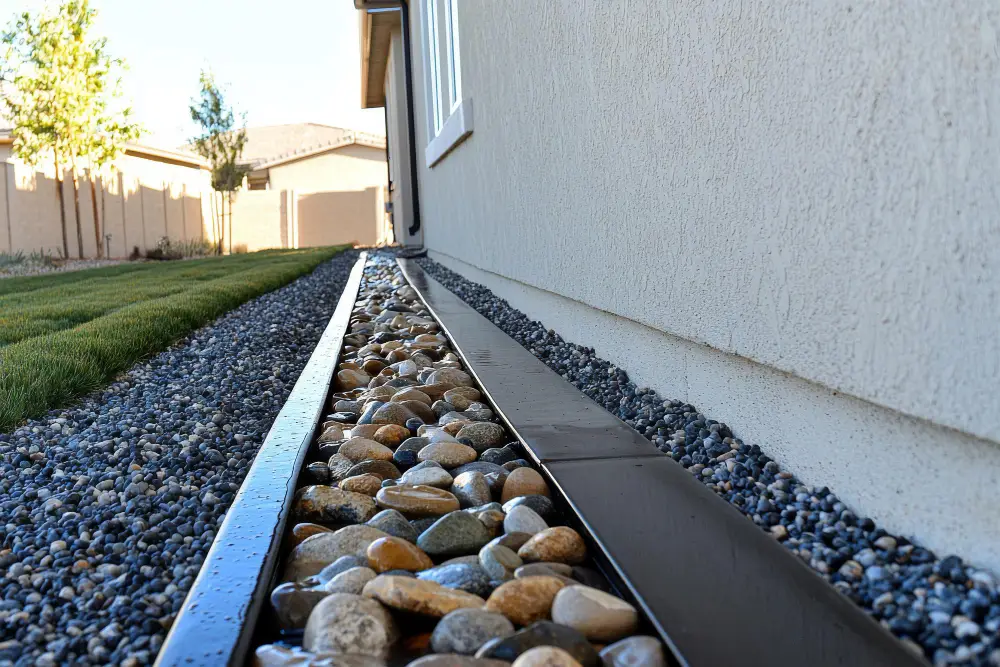
Rock-lined channels handle higher flow rates than grass swales and work well in areas where vegetation struggles. Line the channel with stones large enough to stay in place during storms, typically three inches or larger.
Place landscape fabric beneath the rock to prevent soil from washing up through the stones. Extend the fabric up the sides of the channel and cover the edges with soil or mulch.
Splash Blocks & Energy Dissipation
Even when water must discharge near a gravel driveway, reducing its energy limits erosion.
Positioning Splash Blocks
Splash blocks spread downspout discharge over a wider area, reducing the concentrated flow that causes erosion. Position the block with its low end pointing away from the driveway at an angle that directs water toward a suitable area.
Splash blocks alone may not prevent all erosion if they discharge too close to gravel surfaces. Combine them with extensions or grading to move water further from the driveway.
Rock Aprons
A rock apron at the downspout discharge point absorbs the impact of falling water and spreads the flow over a larger area. This works well when downspouts must discharge near driveways but cannot be extended further.
Dig a shallow depression at the discharge point, approximately two feet in diameter. Fill with large stones, three to six inches in size. The rocks absorb energy from the water and release it more gently.
Grading Solutions
Site grading can direct water away from driveways before it becomes a problem.
Crown the Driveway
A crowned driveway has a high point in the center and slopes down to both edges. Water falling on the surface runs off to the sides rather than flowing down the length of the driveway.
Adding crown to an existing gravel driveway requires bringing in material to build up the center. Spread the material evenly and compact it to create a stable surface. Maintain the crown by regrading periodically.
Grade Adjacent Areas
The ground alongside driveways should slope away from the gravel surface. This prevents runoff from adjacent areas, including downspout discharge, from flowing onto the driveway.
Check the grade around your driveway after heavy rain. Standing water or flow patterns toward the gravel indicate areas that need regrading. Add fill to create positive drainage away from the driveway.
Maintenance & Monitoring
After installing redirection systems, monitor their performance and maintain them as needed.
Check extensions and pipes for clogs, especially after storms that bring leaves and debris. Clear any blockages promptly to prevent overflow.
Inspect dry wells annually by removing the access cover and checking the water level. A well that remains full between storms may have clogged with sediment or may be undersized for the connected roof area.
Maintain swales and channels by removing debris and repairing any erosion. Grass-lined swales need mowing to prevent vegetation from blocking flow.
Dirt Road Repairs specializes in protecting gravel driveways and unpaved surfaces from erosion damage. We design and install gutter redirection systems that keep water away from your driveway and preserve your investment. Contact us to discuss solutions for your property.