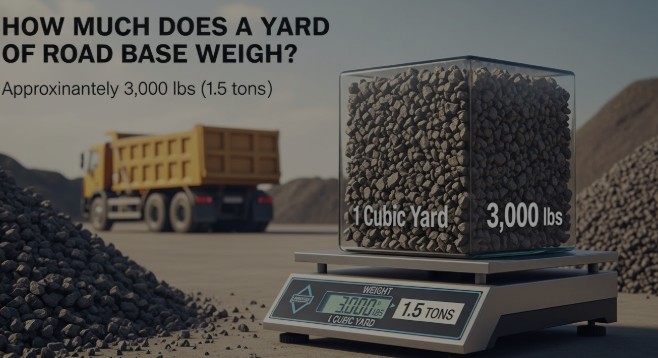
If you’re planning a driveway, road, patio, or any construction project that involves aggregate, one of the most important questions you’ll ask is how much does a yard of road base weigh? The answer directly affects cost, delivery, truck capacity, and structural performance. This guide is written to be the most complete, contractor-grade explanation on the internet, combining real-world averages, industry standards, and practical calculations.
Short Answer — How Much Does a Yard of Road Base Weigh?
A yard of road base typically weighs between 2,200 and 2,700 pounds (1.1–1.35 tons).
The exact weight varies based on:
-
Material type (limestone, granite, recycled)
-
Moisture content (dry vs wet)
-
Compaction level (loose vs compacted)
For most projects, contractors estimate about 2,500 lbs (1.25 tons) per cubic yard as a reliable average.
What Is Road Base and Why Weight Matters
What Is Road Base?
Road base, also called crusher run, aggregate base, or ABC (Aggregate Base Course) is a blended mix of crushed stone and fines designed to compact tightly and provide a stable foundation.
Common Uses
-
Driveways
-
Roads and access paths
-
Patios and walkways
-
Concrete slabs and foundations
Why Knowing the Weight per Yard Is Critical
Understanding how much a yard of road base weighs helps you:
- Avoid overloading trucks
- Estimate material and delivery costs accurately
- Ensure proper compaction and structural stability
- Plan equipment, labor, and timelines
Mistakes here often lead to budget overruns or weak foundations.
How Much Does a Yard of Road Base Weigh in Different Conditions
How Much Does a Yard of Road Base Weigh When Dry
Dry road base generally weighs:
-
2,200–2,400 lbs per cubic yard
This is the best-case scenario for hauling and spreading, as dry material is easier to work with and places less stress on vehicles.
How Much Does a Yard of Road Base Weigh When Wet
When saturated with moisture, road base can weigh:
-
2,500–2,700+ lbs per cubic yard
Rainwater fills the voids between particles, dramatically increasing weight. This is why deliveries after rainfall are often limited to fewer yards per truck.
How Much Does a Yard of Road Base Weigh When Compacted
Compacted road base has a higher density per volume:
-
Loose: ~2,300–2,500 lbs/yd³
-
Compacted (in-place): effectively heavier per finished area
While the delivered weight stays the same, coverage area shrinks after compaction, which many people overlook.
Average Weight of Road Base Per Cubic Yard (Industry Standards)
-
Pounds: 2,200–2,700 lbs per cubic yard
-
Tons: 1.1–1.35 tons per cubic yard
Most quarries and suppliers quote road base as:
1.25 tons per cubic yard (average contractor standard)
Regional Variations
-
Limestone base: slightly lighter
-
Granite base: slightly heavier
-
Recycled base: weight varies widely depending on composition
Road Base Weight by Type
| Road Base Type | Weight per Cubic Yard (lbs) | Weight per Cubic Yard (tons) | Typical Use Case |
|---|---|---|---|
| Crusher Run | 2,400–2,600 | 1.2–1.3 | Driveways, roads |
| Class 5 Road Base | 2,300–2,500 | 1.15–1.25 | Pavement base |
| Limestone Base | 2,200–2,400 | 1.1–1.2 | Residential projects |
| Granite Base | 2,500–2,700 | 1.25–1.35 | Heavy-duty roads |
| Recycled Road Base | 2,000–2,600 | 1.0–1.3 | Budget applications |
Road Base vs Other Aggregates (Weight Comparison)
Road Base vs Gravel (Weight per Yard)
Road base is heavier than gravel because of fines that fill gaps and increase density.
Road Base vs Crushed Stone
Crushed stone without fines is lighter and drains better, but lacks compaction strength.
Road Base vs Sand
Sand weighs less (~2,000 lbs/yd³) and is unsuitable as a structural base.
Road Base vs 57 Stone
57 stone drains well but weighs less and doesn’t compact tightly like road base.
How to Calculate Road Base Weight for Your Project
Step 1 — Measure Area (Length × Width × Depth)
Example:
20 ft × 10 ft × 0.5 ft (6 inches)
Step 2 — Convert Depth to Yards
6 inches = 0.167 yards
Step 3 — Calculate Cubic Yards Needed
(20 × 10 × 0.5) ÷ 27 = 3.7 cubic yards
Step 4 — Multiply by Road Base Weight per Yard
3.7 × 2,500 lbs = 9,250 lbs
Step 5 — Adjust for Waste and Compaction
Add 10–15% extra to account for compaction and material loss.
How Many Tons Is a Yard of Road Base
-
1 cubic yard ≈ 1.25 tons
-
Contractor rule of thumb:
4 yards ≈ 5 tons
Suppliers quote in tons because truck limits are weight-based, not volume-based.
Truckload Capacity — How Many Yards of Road Base Per Truck
-
Pickup truck: 0.25–0.5 yard max
-
Small dump truck: 3–5 yards
-
Full-size dump truck: 10–15 yards
DOT regulations cap loads by gross vehicle weight, especially when material is wet.
Cost Implications — Why Road Base Weight Affects Price
-
Delivery fees are calculated by weight
-
Over-ordering increases hauling and labor costs
-
Under-ordering causes project delays
-
Heavier material requires stronger equipment and more labor
Knowing how much a yard of road base weighs helps prevent expensive mistakes.
Common Mistakes People Make When Estimating Road Base Weight
-
Confusing gravel with road base
-
Ignoring moisture content
-
Forgetting compaction shrinkage
-
Assuming all stone weighs the same
These errors often lead to shortages or unsafe loads.
FAQs — How Much Does a Yard of Road Base Weigh?
How much does a yard of road base weigh on average?
About 2,500 lbs or 1.25 tons.
Is road base heavier than gravel?
Yes, due to fines that increase density.
How many pounds are in a yard of road base?
Typically 2,200–2,700 pounds.
How many tons is one yard of road base?
Roughly 1.1–1.35 tons.
Does wet road base weigh more?
Yes—moisture can add hundreds of pounds per yard.
How much road base do I need for a driveway?
Most driveways require 4–6 inches compacted depth.
Can I haul a yard of road base in a pickup truck?
No. A full yard exceeds most pickup limits.
Is crushed limestone road base heavier than granite?
Granite is usually heavier than limestone.
Final Thoughts — Choosing the Right Amount of Road Base by Weight
Understanding how much does a yard of road base weigh is essential for accurate budgeting, safe hauling, and long-lasting construction. While 1.25 tons per yard is a solid average, always factor in material type, moisture, and compaction. For best results, confirm exact weights with your local supplier and order slightly extra to account for compaction. For more information visit DIrt Road Repairs now!
Whether you’re a homeowner or a contractor, accurate weight estimation is the foundation of a successful project.