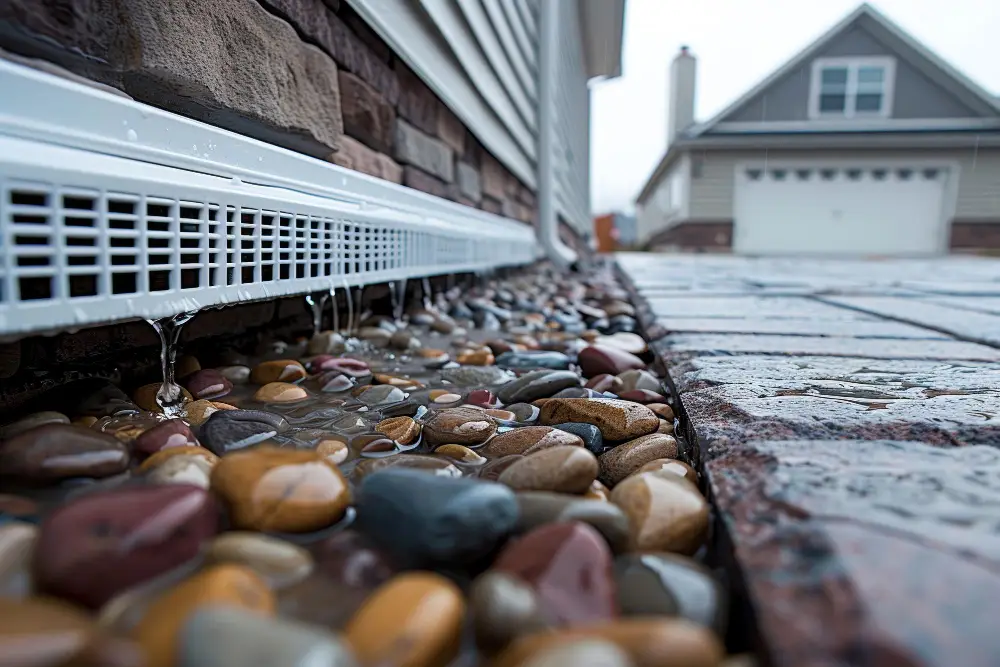
Property owners dealing with drainage problems often consider both French drains and gutter downspout systems as possible solutions. These two approaches handle water differently and work best in different situations. Choosing the right option, or combining both for a complete solution, depends on the water sources you need to manage and the conditions on your property.
How Gutter Downspouts Work
Gutter systems collect rainwater that falls on roof surfaces and channel it through downspouts to discharge points at ground level. The system intercepts water before it hits the ground and delivers it to controlled locations.
Components & Function
Gutters mount along the edge of the roof and catch water as it runs off. The collected water flows through the gutter channel, following a slight slope toward the downspouts. Downspouts are vertical pipes that carry water from the gutter down to ground level.
At the bottom of each downspout, an elbow directs water away from the foundation. Extensions, splash blocks, or underground pipes can carry the discharge further from the building.
What Downspouts Address
Gutter downspouts handle roof runoff only. They collect water that falls on the roof and nothing else. This water is relatively clean and arrives in concentrated volumes during and immediately after rain.
The volume is predictable based on roof size and rainfall amount. A 1,000-square-foot roof produces about 600 gallons of runoff per inch of rainfall. All of this water must go somewhere, and downspouts determine where.
Limitations of Downspouts Alone
Downspouts do not address groundwater, surface water from other sources, or water that has already soaked into the soil. They handle only what the gutters collect.
If water problems persist after installing gutters and properly directing downspouts, other water sources are involved. Groundwater seeping into a basement, surface water running from neighboring properties, and high water tables are not solved by gutter improvements.
How French Drains Work
French drains collect and remove water from the soil. They intercept groundwater, capture surface water that soaks into the ground, and provide an outlet for water that has nowhere else to go.
Components & Function
A French drain consists of a trench filled with gravel, typically containing a perforated pipe at the bottom. Water enters the trench from the surrounding soil, flows through the gravel into the pipe, and travels through the pipe to a discharge point.
The pipe has holes or slots that allow water to enter but prevent soil from getting inside. Landscape fabric wrapped around the gravel keeps fine particles from clogging the system over time.
What French Drains Address
French drains handle subsurface water. This includes groundwater that moves laterally through the soil, water that soaks down from the surface, and water that seeps up from high water tables.
French drains work well for:
Wet areas in yards where water pools after rain Basement walls where groundwater creates moisture problems Retaining walls where water pressure builds behind the structure Low spots that collect runoff from surrounding areas
Limitations of French Drains Alone
French drains do not intercept roof runoff before it hits the ground. Installing a French drain without gutters means the drain must handle both groundwater and the full volume of roof runoff that soaks into the soil.
This increases the load on the French drain significantly. A drain sized for normal groundwater conditions may be overwhelmed when roof runoff adds hundreds of gallons during each storm.
French drains also require an outlet. The collected water must go somewhere, typically to a lower area of the property, a storm drain, a dry well, or a ditch. Properties without suitable outlets may struggle to discharge French drain water effectively.
Comparing Performance
The two systems excel in different scenarios. Being aware of these differences helps you choose the right approach.
Handling Roof Water
Gutter downspouts are far more effective at managing roof water. They intercept the water at the source and concentrate it for easy management. The discharge can be piped anywhere on the property, stored in rain barrels, or directed to specific drainage features.
French drains can handle roof water only after it has soaked into the ground. By that point, the water has saturated the soil around your foundation, contributed to hydrostatic pressure against basement walls, and caused the wet conditions you want to avoid.
For roof water management, gutters with properly directed downspouts are the clear choice.
Handling Groundwater
French drains are designed specifically for groundwater and are highly effective at intercepting it. Groundwater moves slowly through soil, giving the French drain time to collect it before it reaches foundations or use areas.
Gutter downspouts have no effect on groundwater. Water that seeps through the soil from neighboring properties, rises from high water tables, or percolates down from surface absorption will not be captured by gutters.
For groundwater problems, French drains are necessary.
Handling Surface Water from Other Sources
Surface water from driveways, patios, neighboring properties, and overland flow requires surface drainage solutions. Neither gutter downspouts nor French drains are the primary tools for this water.
Swales, grading, and surface drains intercept overland flow before it reaches problem areas. French drains can capture this water after it soaks in, but preventing surface flow with grading is more effective.
Cost Comparison
Gutter systems typically cost less to install than French drains. A complete gutter system for an average home runs $1,000 to $3,000 installed. The system handles all roof water and requires minimal ongoing maintenance beyond periodic cleaning.
French drains cost $20 to $50 per linear foot installed, depending on depth, pipe size, and soil conditions. A French drain protecting one side of a foundation might run 50 to 100 feet, costing $1,000 to $5,000.
Many properties need both systems. The combined cost addresses different water sources and provides more complete protection than either system alone.
Maintenance Requirements
Gutters need cleaning two to four times per year to remove leaves and debris. Downspouts occasionally clog and need clearing. Extensions and splash blocks may shift and require repositioning.
French drains require less frequent attention but more significant work when problems occur. A clogged French drain may need excavation to clear or replace the pipe. Roots can grow into the pipe and block flow. Sediment can accumulate and reduce capacity over time.
Properly installed French drains with good fabric protection often function for 20 years or more with minimal maintenance. Gutters last 20 to 30 years but need regular attention throughout their lifespan.
When to Use Each System
The water source determines which system you need.
Choose Gutters When
You need to manage roof runoff to prevent erosion near foundations, protect driveways and walkways, or control discharge locations. If your problems occur during rain and stop shortly after, roof water is likely the source and gutters are the solution.
Choose French Drains When
You have wet areas that stay saturated long after rain ends, basement moisture that persists regardless of weather, or groundwater that seeps from slopes above your building. These conditions indicate subsurface water that gutters cannot address.
Use Both When
Most properties benefit from both systems. Gutters handle the roof water efficiently, keeping it out of the ground entirely. French drains handle any groundwater or subsurface seepage that reaches the building. The two systems complement each other rather than competing.
A common installation pairs gutter downspouts that discharge into French drain systems. The French drain then carries both the roof water and any groundwater to a common outlet. This integrated approach provides drainage for multiple water sources.
Making the Right Choice for Your Property
Assess your water sources before choosing a system. During and after rain, observe where water comes from and where it goes. Note areas that stay wet and how long they take to dry.
If the problems relate directly to rainfall and stop within hours of the rain ending, gutters and downspout management will likely solve them. If problems persist for days after rain or occur without recent precipitation, groundwater is involved and French drains become necessary.
Dirt Road Repairs evaluates drainage problems and recommends the right solutions for each property. We install gutter systems, French drains, and combined approaches that address all your water sources. Contact us for an assessment and recommendation made considering your situation.