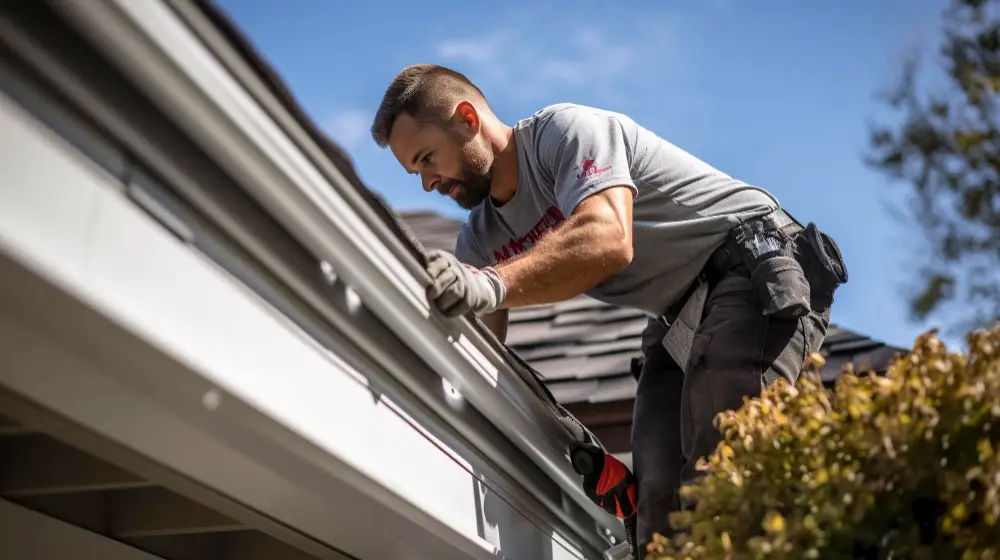
Homeowners with basic construction skills can install gutters themselves on single-story buildings with straightforward rooflines. The work requires comfort working from ladders, access to common tools, and time to complete the project carefully. Success depends on realistic assessment of your abilities, the project complexity, and your willingness to invest the time needed to do quality work.
Suitable Projects for DIY Installation
Small sheds, detached garages, and single-story home additions are good candidates for DIY gutter installation. These buildings have manageable heights, shorter gutter runs, and simpler configurations than whole-house projects.
Single-story homes with simple rooflines can work for DIY installation if you are comfortable at heights and have helpers available. Straight runs along one or two sides of a building involve less complexity than installations wrapping around multiple corners.
Projects using sectional gutters are more DIY-friendly than those requiring seamless gutters. Sectional components are available at hardware stores, and the installation does not require special equipment beyond hand tools.
When to Hire Professionals
Two-story homes present safety challenges that make professional installation worth considering. The ladder heights required, the difficulty of handling materials at elevation, and the increased fall risk lead many homeowners to hire contractors for upper-level work.
Complex rooflines with multiple valleys, dormers, and roof level changes require experience to handle properly. Each transition needs correct fitting and sealing. Mistakes on complex configurations often result in leaks and drainage problems.
Buildings without standard fascia boards, including many metal buildings and pole barns, require adapted installation methods. These situations benefit from contractor experience with non-standard construction.
Homeowners who are uncomfortable at heights should hire professionals regardless of building complexity. No amount of money saved justifies injury from a fall.
Skills & Capabilities Needed
You must be comfortable working from a ladder at heights up to 15 feet or more. This means climbing up and down repeatedly, working with both hands while maintaining balance, and not experiencing fear or dizziness at elevation.
Basic carpentry skills help with measuring, cutting, and fastening. You need to measure accurately, mark cut lines, and make straight cuts in metal or vinyl. Experience with similar projects makes gutter installation easier.
Physical capability to handle materials and work overhead matters. Gutter sections are awkward and require control while positioning them. Reaching to fasten hangers and working in uncomfortable positions is part of the job.
Following instructions and problem-solving help when assembly does not go as planned. Reading manufacturer guidelines, watching instructional videos, and adapting when faced with situations the instructions do not cover all factors into success.
Realistic Time Commitment
Plan for the project to take longer than estimates suggest. A straight 40-foot gutter run might take an experienced installer 3 to 4 hours. A first-time DIYer should expect 6 to 8 hours for the same work.
Whole-house installations that professionals complete in a day may take a DIYer an entire weekend or more. Factor in time for purchasing materials, setting up work areas, and correcting mistakes.
Starting the project with the expectation that it will consume significant time prevents frustration when work progresses more slowly than hoped.
Tools & Materials Needed
Successful DIY installation requires having or purchasing the right tools. A ladder tall enough to reach the work area safely, a drill with a variety of bits, tin snips or a miter saw for cutting, a tape measure and chalk line, a level, a pop rivet gun, a caulk gun, and basic hand tools all contribute to the project.
Materials include gutter sections, hangers, corners, end caps, drop outlets, downspout sections and elbows, sealant, fasteners, and splash blocks or extensions for discharge. Purchasing 10 percent more than measurements indicate accounts for cutting waste and mistakes.
Cost Savings vs. Professional Installation
Installing gutters yourself saves labor costs. Professional installation runs $3 to $7 per linear foot for labor. On a 150-foot project, labor costs $450 to $1,050.
You still pay for materials, which run $5 to $12 per linear foot for sectional gutters. Material costs for a 150-foot project total $750 to $1,800.
The savings is real but consider the time investment and the risk of errors that require correction. Mistakes with slope, leaking joints, or inadequate drainage may result in systems that do not function properly.
Learning Resources Available
Many resources help DIY installers learn techniques before starting. Manufacturer instructions included with materials provide step-by-step guidance. Online videos demonstrate installation procedures. Home improvement websites offer written guides with photos.
Spending time with these resources before purchasing materials helps you understand what is involved and make realistic decisions about attempting the work yourself.
Making the Decision
Assess your comfort at heights honestly. If you feel unsafe or anxious on ladders, hire professionals.
Evaluate the building complexity. Simple single-story structures are DIY-friendly. Complex or tall buildings warrant professional work.
Consider your available time. If you have weekends available and enjoy DIY projects, the work can be satisfying. If time is limited or you would rather focus on other priorities, professional installation makes sense.
Dirt Road Repairs provides professional gutter installation for homeowners who prefer to hire the work done. We complete projects efficiently and stand behind our work with warranties. Contact us for a quote and comparison with DIY costs.