Stop guessing at the quarry. Using the wrong stone in the wrong layer guarantees failure.
The Most Common Gravel Driveway Mistake
You call the gravel yard, and they ask the million-dollar question: Do you want Crush & Run or #57 Stone?
Most homeowners freeze. They think these are just two different flavors of the same thing like choosing between red or white paint. They usually pick the one that looks nicer or costs less.
This is the single biggest mistake in driveway construction.
Crush & Run and #57 Stone are not competitors. They are teammates with completely different jobs. Asking Which one is better? is like asking Which is better for a house: Concrete or Shingles? You need both, but if you put shingles on the foundation, the house collapses.
The Reality: These materials are not interchangeable. Using the wrong one in the wrong place guarantees your driveway will sink, rut, or turn into a mud pit.
First, Understand a Driveway Is a SYSTEM (Not a Pile of Gravel)
Before you order a single ton of rock, you need to change how you look at your driveway. A driveway is not just a layer of gravel dumped on the dirt. It is a Load Bearing Structure.
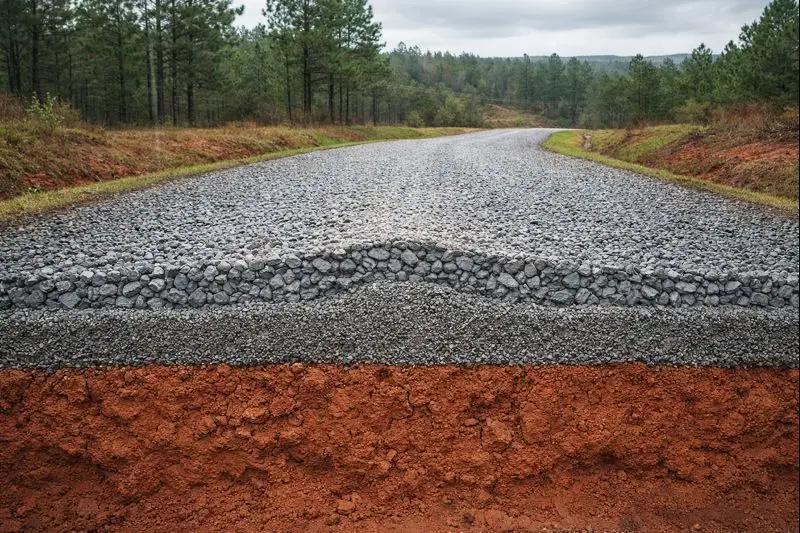
Just like a road, a rural driveway has layers:
- The Subgrade: The native soil underneath (usually Georgia red clay).
- The Base Layer: The heavy-lifting layer that provides strength and prevents sinking.
- The Surface Layer: The wearing course that provides traction, drainage, and a clean look.
If you skip the system and just dump rock, gravity and rain will destroy your investment in months.
What Is Crush & Run? (The BASE Material)
Also Known As: Crusher Run, GAB (Graded Aggregate Base), ABC Stone.
The Definition:
Crush & Run is a mixture of crushed stone (usually 3/4 inch to 1 inch) combined with Fines (stone dust/powder). It looks messy and dirty compared to clean stone.
Why It Is The Base King:
The magic is in the dust. When you spread Crush & Run and compact it, the dust fills the tiny air gaps between the rocks. Once it gets wet and dries, it hardens almost like concrete.
- Compaction: It locks together tight.
- Stability: It creates a solid bridge over soft soil so your car doesn’t sink.
- Impermeability: It sheds water off the top rather than letting it soak through quickly.
Best Uses:
- The Foundation/Base of every driveway.
- Steep slopes where loose rock would roll away.
- Filling deep potholes.
What Is #57 Stone? (The SURFACE Material)
Also Known As: Clean Stone, Drain Rock.
The Definition:
#57 Stone is crushed rock that has been washed and screened. It is uniform in size (about the size of a walnut or golf ball). Most importantly, it has ZERO dust.
Why It Is The Surface Queen:
Because there are no fines to hold it together, water flows straight through the gaps. It stays clean.
- Drainage: Water vanishes instantly, preventing puddles.
- Aesthetics: It looks crisp, clean, and grey. It doesn’t track mud onto your porch or tires.
- Maintenance: It is easy to rake and smooth out.
Best Uses:
- Top Surface Layer (The top 2 inches).
- Covering French Drains.
- Flat or gently sloped driveways.
The Biggest Mistake: Swapping Their Roles
Here is why most DIY driveways fail within a year:
Mistake A: Using #57 Stone as a Base
If you dump clean #57 stone directly onto soft clay, there is no locking action. The weight of your truck will push the stones down into the mud. The clay will ooze up through the gaps (Mud Pumping).
- Result: Your expensive gravel disappears into the earth.
Mistake B: Using Crush & Run as a Surface (On Flat Ground)
If you use Crush & Run as your only layer, especially on a flat area near the house, you will regret it when it rains. The stone dust turns into a gritty paste.
- Result: You track grey sludge into your garage, and the driveway stays wet and mushy for days because it can’t drain.
Base vs. Surface Comparison
| Feature | Crush & Run (The Base) | #57 Stone (The Surface) |
| Primary Job | Strength & Support | Drainage & Looks |
| Contains Dust? | ✅ YES (Lots of it) | ❌ NO (Clean) |
| Compaction | High (Hardens like cement) | Low (Stays loose) |
| Water Flow | Sheds water off | Lets water through |
| Best Placement | Bottom Layer (4-6 inches) | Top Layer (1-2 inches) |
When Soil Conditions Change the Answer
In a perfect world, every driveway is flat and dry. But in Georgia, we deal with red clay and hills.
- Soft / Wet Clay: If your ground is mushy, even Crush & Run might sink. In this case, we install Geotextile Fabric first to separate the mud from the rock. The Base matters 10x more than the surface here.
- Steep Hills: Gravity hates #57 Stone. On a steep driveway, clean stone acts like marbles it rolls downhill when you drive on it. On steep slopes, Crush & Run is often used as both the base and the surface because it provides the traction needed to get up the hill.
The Correct Professional System (How It’s Done Right)
A professional doesn’t just spread gravel. We engineer a system. Here is the Dirt Road Repairs standard:
- Grading: We cut out the organic soil and shape the road.
- Separation (Optional): We lay Geotextile Fabric if the soil is weak.
- The Base: We install 4-6 inches of Crush & Run.
- Compaction: We vibrate and roll the base until it is rock-hard.
- The Surface: We top it with 1 2 inches of #57 Stone for that clean, finished look.
Professional Rule: We invest 70% of the budget in the Base, and 30% in the Surface. Most homeowners do the opposite.
Compaction: Why Material Alone Is Not Enough
You can buy the best Crush & Run in the state, but if you don’t compact it, it’s useless.
- Hand Tamping? Useless on a driveway.
- Driving Your Truck Over It? Not enough pressure.
- Vibratory Roller: This is mandatory.
The vibration shakes the fines (dust) into the gaps, and the heavy drum locks the stones together. Without a roller, Crush & Run is just loose dirt and rocks waiting to wash away.
Drainage Still Wins (No Gravel Fixes Bad Water Flow)
Let’s be honest: You can have the perfect layers of #57 and Crush & Run, but if water flows down the middle of your road, it will destroy it.
- No Crown? Water pools and softens the base.
- No Ditches? Water floods the road.
Gravel is the skin of the driveway. Drainage is the skeleton. If the skeleton is broken, the skin will fail.
Maintenance Expectations
- #57 Stone Surface: Will migrate. You will need to rake it back to the center occasionally. It’s a moving surface.
- Crush & Run Base: Once hardened, it should not move. If your base is moving, you have a drainage failure.
Tip: Adding more #57 stone to a pothole never works. You must dig down and fix the Base (Crush & Run) first.
Cost Reality: Using Both Saves Money
But isn’t buying two types of rock more expensive?
Actually, Crush & Run is usually cheaper per ton than washed #57 stone. By using the cheaper stone for the thick base layer and saving the expensive pretty stone for the thin top layer, you get a stronger driveway for roughly the same price.
Plus, you won’t be buying replacement gravel every spring.
Quick Decision Guide
- Building a new driveway? -> 6 Crush & Run Base + 2 #57 Surface.
- Fixing a muddy bog? -> Geotextile Fabric + Crush & Run.
- Top dressing a steep hill? -> Crush & Run (for traction).
- Top dressing a flat driveway? -> #57 Stone (for cleanliness).
Conclusion: Right Stone, Right Layer, Right Result
Gravel driveways don’t fail because gravel is a bad material. They fail because the wrong gravel was used in the wrong layer.
Stop treating your driveway like a dumping ground for rocks. Build it like a road. Give it a strong Crush & Run spine and a clean #57 Stone skin.
Professional Diagnosis Over Guesswork
Not sure what your soil needs? Don’t guess with a 20-ton delivery.
We inspect your soil stability, slope, and drainage before we recommend a single stone.
Get a Driveway That Lasts.
📞 Call Dirt Road Repairs: 770-771-3977
📅 Schedule an Evaluation