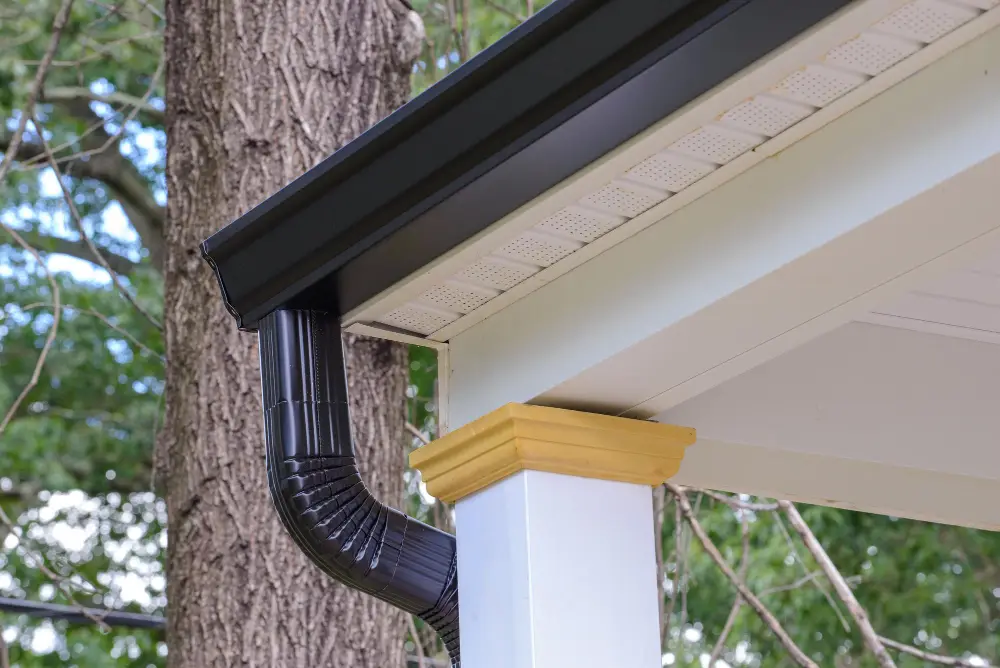
Gutter hangers should be spaced no more than 24 inches apart in most residential applications. This spacing provides adequate support for the weight of the gutter, water, and accumulated debris. Some situations require closer spacing to handle additional loads or challenging conditions.
Standard Spacing for Residential Gutters
The 24-inch maximum spacing applies to aluminum gutters in typical residential installations. This distance supports the gutter under normal loads including water during heavy rain and moderate debris accumulation.
Measure from the center of one hanger to the center of the next when establishing spacing. If hangers are 24 inches apart, the gutter has a hanger every two feet along its length.
Position the first hanger within three inches of any seam, corner, or end cap. These locations need support close to the connection point to prevent stress on joints.
The last hanger in a run should also be within three inches of the end. This prevents the final section from sagging or pulling away from the fascia.
Closer Spacing for Snow & Ice
Regions with heavy snow and ice loads require closer hanger spacing. Snow sliding off the roof can pile into gutters. Ice forming in gutters adds significant weight. Standard 24-inch spacing may not provide enough support under these conditions.
Reduce spacing to 18 inches between hangers in areas that receive substantial winter precipitation. This applies to locations that regularly see snow accumulation on roofs and ice forming in gutters.
Some contractors in severe snow regions space hangers every 12 inches for additional support. This provides the strength to handle extreme ice loads without gutter failure.
Check local building codes for specific requirements in your area. Codes in snow regions often mandate closer hanger spacing than the national standard.
Spacing for Different Materials
Aluminum gutters follow the standard 24-inch spacing, reduced to 18 inches in snow regions. This applies to both sectional and seamless aluminum gutters.
Vinyl gutters benefit from closer spacing because the material has less rigidity than metal. Many manufacturers recommend 18-inch spacing for vinyl regardless of climate. This prevents sagging between hangers that is more common with plastic gutters than aluminum.
Steel gutters, being heavier than aluminum, place more load on hangers. While 24-inch spacing works for steel in most conditions, the increased weight means some installers prefer 18-inch spacing for added security.
Copper gutters use the same spacing guidelines as aluminum. The material properties are similar enough that 24-inch spacing, or 18 inches in snow regions, provides adequate support.
Hanger Types & Spacing
Different hanger styles affect how spacing requirements work in practice.
Hidden hangers that mount inside K-style gutters and screw through the back into the fascia follow standard spacing guidelines. These hangers provide strong support and work well at 24-inch intervals.
Strap hangers that wrap under the gutter and attach to the roof deck can be spaced slightly farther apart in some applications because they support the gutter along a broader area. However, 24-inch maximum spacing remains a good practice.
Spike and ferrule systems, where a long spike drives through the gutter and a tube inside it into the fascia, tend to loosen over time. These older systems benefit from closer spacing and regular maintenance to tighten spikes that work loose.
Bracket-style hangers that attach to the fascia and support the gutter from below follow the same spacing as hidden hangers. The support method differs but the loads are similar.
Adjusting Spacing for Building Conditions
Fascia board condition affects hanger holding power. Solid, sound fascia supports hangers reliably at standard spacing. Soft or deteriorating fascia needs repair before hanging gutters, but in borderline conditions, closer hanger spacing distributes load over more attachment points.
Long gutter runs benefit from consistent spacing throughout. A 40-foot run with 24-inch spacing has approximately 20 hangers. Skipping locations or spacing unevenly creates weak spots where sagging is likely.
Gutter weight varies by size and material. Six-inch gutters are heavier than five-inch and may warrant closer spacing even when not in snow regions. The modest increase in installation time and materials prevents problems later.
Installation Sequence
Mark hanger locations along the chalk line that establishes gutter slope before installing any hangers. This ensures even spacing and proper positioning.
Install hangers progressively from one end of the run to the other. Check spacing as you go to catch errors before they compound.
If the measurement does not divide evenly, adjust spacing slightly so hangers distribute evenly rather than ending with a very short or very long interval at the end. For example, on a 50-foot run, you might use 23-inch spacing to come out even rather than having 24-inch spacing that leaves an odd gap at the end.
Dirt Road Repairs installs gutter hangers at appropriate spacing for local conditions and building requirements. We understand how climate, materials, and building characteristics affect proper installation practices. Contact us for professional gutter installation that follows best practices and local codes.