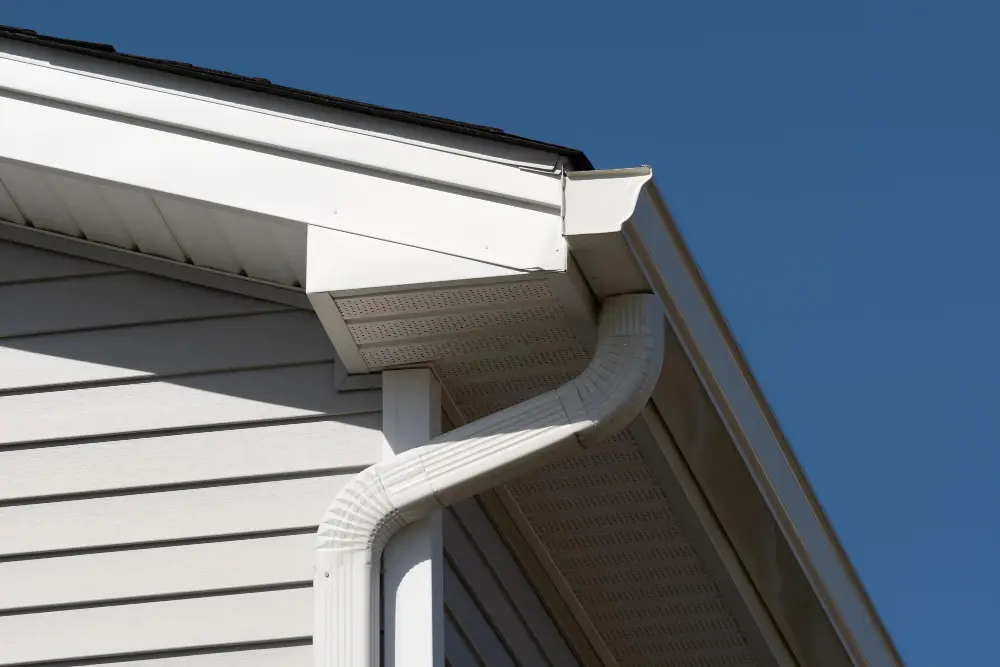
Gutters are manufactured and installed in two different ways. Sectional gutters come in pre-cut lengths that connect together on site. Seamless gutters are formed continuously in lengths matching the building dimensions. These construction methods affect cost, appearance, performance, and longevity. Being in the know of the differences helps property owners make informed decisions.
How Sectional Gutters Are Made & Installed
Sectional gutters are manufactured in standard lengths, typically 10 feet, and sold at building supply stores and home centers.
Manufacturing Process
Factories produce gutter sections in large quantities. The process involves feeding flat metal or vinyl through forming machines that bend it into the gutter profile. Sections are cut to standard lengths, painted if metal, and packaged for distribution.
This mass production keeps costs down. The standardization means components from different manufacturers often fit together, giving property owners choices when purchasing materials.
Installation Method
Installing sectional gutters involves measuring the building, cutting sections to approximate lengths, and joining them together to create continuous runs. Connections use overlapping joints with sealant and mechanical fasteners such as rivets or screws.
Corners, end caps, and drop outlets attach using the same methods. The assembled gutter runs are then hung on brackets or hangers attached to the fascia.
Because sections ship and store easily, homeowners can purchase materials themselves and complete installations without special equipment. This makes sectional gutters suitable for DIY projects.
Joint Characteristics
Every 10 feet of sectional gutter has a joint where sections connect. A 40-foot gutter run has approximately four joints plus connections at corners and downspouts.
Each joint requires careful alignment, sealing, and fastening. Quality at these joints determines how well the system resists leaks. Poorly executed joints begin leaking within a few years. Properly sealed and fastened joints last for decades.
Availability & Repair
Replacement sections, components, and parts for sectional gutters are available at hardware stores. When damage occurs or when expanding the system, obtaining matching materials is straightforward.
This availability simplifies repairs. A damaged section can be cut out and replaced without disturbing the rest of the system. Homeowners can make repairs themselves using parts from local suppliers.
How Seamless Gutters Are Made & Installed
Seamless gutters are formed on-site from continuous rolls of material. A portable gutter machine produces gutters in lengths up to 100 feet or more without seams.
Manufacturing Process
Contractors purchase rolls of flat aluminum or steel. At the job site, they feed the material through a portable gutter machine mounted on a truck or trailer. The machine bends the flat material into the gutter profile as it passes through.
The contractor measures the building and forms gutter sections to exact lengths. A 50-foot run becomes a single piece. The machine produces the gutter continuously, so length is limited only by handling considerations rather than manufacturing constraints.
Installation Method
Installing seamless gutters requires professional contractors with forming equipment. Homeowners cannot purchase seamless gutters or complete the work themselves.
Contractors form sections to length, position them on the building, and attach them to hangers or brackets. Joints occur only at corners where direction changes and at drop outlets for downspouts.
The reduced number of connections means less time spent sealing and fastening joints. Installation may take less time overall despite the equipment setup requirements.
Joint Characteristics
A 50-foot seamless gutter run has no joints along its length. Connections exist only at corners and downspout locations. This reduces the total number of possible leak points significantly compared to sectional gutters.
Corners and drop outlets still require proper sealing and fastening. These joints use the same techniques as sectional gutters, but there are far fewer of them.
Limited DIY & Repair Options
Property owners cannot form seamless gutters themselves. Repairs requiring new sections mean calling a contractor with forming equipment.
If a seamless gutter section is damaged beyond repair, replacing it requires forming a new section on-site. The contractor must bring the machine to your property, which adds to repair costs compared to sectional systems where a replacement section can be purchased and installed quickly.
Comparing Performance
Direct comparison shows how these construction methods affect gutter system performance.
Leak Resistance
Seamless gutters develop fewer leaks over their service life. The elimination of joints along runs removes the main source of leaks in gutter systems.
Sectional gutters leak at joints when sealant fails, fasteners loosen, or sections shift. Even well-installed sectional systems develop joint leaks eventually as materials age and sealant deteriorates.
The difference matters most on long gutter runs and in climates with freeze-thaw cycles that stress joints. For short runs on small buildings, the advantage is less significant.
Appearance
Seamless gutters create clean lines without visible joints. The single continuous section looks more finished than gutters with joints every 10 feet.
From the ground, the difference is subtle. Up close, seamless construction is clearly different from sectional. For property owners concerned with appearance, seamless offers a cleaner look.
Strength & Rigidity
A continuous seamless section has no weak points along its length. The gutter maintains consistent strength from end to end.
Sectional gutters have possible weak points at every joint. Even with proper fastening, joints are less strong than the material on either side. Under load from ice or debris, joints can separate.
Thermal Expansion
Long gutter runs expand and contract with temperature changes. Aluminum expands about one inch per 50 feet when temperature changes by 100 degrees.
Seamless gutters may require expansion joints on very long runs to accommodate this movement. Without expansion joints, the gutter can buckle or pull away from the fascia.
Sectional gutters accommodate expansion at the joints between sections. The small gaps allow movement without causing stress. This can be an advantage in climates with temperature extremes.
Comparing Cost
Cost differences affect which option property owners choose.
Material & Labor Costs
Sectional gutter materials cost $5 to $12 per linear foot. Installation labor costs $3 to $7 per linear foot. Total installed cost ranges from $8 to $19 per linear foot.
Seamless gutter installation costs $7 to $14 per linear foot including materials and labor. The contractor’s pricing includes the cost of forming equipment and the expertise to operate it.
For a 150-foot installation, sectional gutters cost $1,200 to $2,850 installed. Seamless gutters cost $1,050 to $2,100 installed. The ranges overlap, and in many cases, costs are similar.
DIY Savings
Property owners who install sectional gutters themselves save all labor costs. Materials alone run $750 to $1,800 for a 150-foot project. The savings is $450 to $1,050 compared to professional installation.
Seamless gutters offer no DIY option. Professional installation is required, eliminating the possibility of saving through owner labor.
Long-Term Costs
Seamless gutters may cost less over their lifetime because of reduced maintenance and fewer repairs related to joint failures.
Sectional gutters need resealing at joints periodically. Some property owners reseal every 5 to 10 years to prevent leaks. This maintenance costs time and materials or professional labor if hired out.
The long-term cost difference depends on how long the system remains in service and what maintenance is required. Well-maintained sectional gutters can approach seamless longevity. Neglected sectional gutters fail sooner.
Choosing Between Seamless & Sectional
Several factors guide the decision between these two options.
Choose seamless gutters when you want minimum leak potential, prefer a cleaner appearance, have long gutter runs where joint reduction matters, plan to hire professional installation anyway, or want to minimize long-term maintenance.
Choose sectional gutters when you plan to install gutters yourself, need to minimize upfront costs, have multiple small buildings where seamless advantages are minimal, want the ability to make repairs with readily available parts, or prefer the flexibility of incremental upgrades and additions to the system.
Both options provide effective water management when installed and maintained properly. The choice comes down to priorities, budget, and if you plan to do the work yourself or hire professionals.
Dirt Road Repairs installs both seamless and sectional gutter systems. We help property owners evaluate which option suits their building, budget, and preferences. Contact us to discuss gutter installation and receive quotes for both seamless and sectional systems.