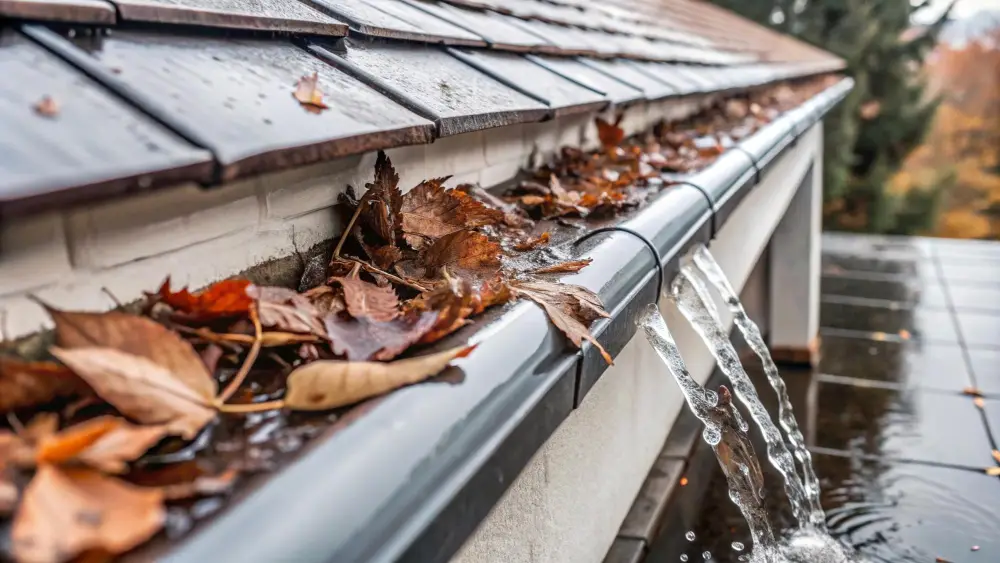
Overflowing gutters defeat their purpose of directing water away from your home. Instead of channeling rainwater to downspouts, overflow dumps water directly at the foundation line where it causes erosion, basement moisture, and structural damage. Identifying the cause of overflow leads to the right fix for your situation.
Clogged Gutters
The most common cause of gutter overflow is clogging from debris accumulation. Leaves, twigs, seeds, and other organic material build up in the gutter channel and block water flow.
How Clogs Cause Overflow
As debris accumulates, it restricts the space available for water. During rain, water backs up behind the blockage. When the backup reaches the front edge of the gutter, water spills over.
Clogs often form near downspouts where debris washes and accumulates. A single clog at the downspout opening can cause an entire gutter run to overflow.
Fixing Clogged Gutters
Remove debris by hand, with a gutter scoop, or using specialized cleaning tools. Flush the cleaned gutter with a garden hose to verify water flows freely to the downspout.
Clear the downspout by inserting a hose from the top and running water at full pressure. For stubborn clogs, use a plumber’s snake to break up the blockage.
Prevent future clogs by cleaning gutters at least twice yearly, in spring and fall. Consider installing gutter guards if debris accumulation is a persistent problem.
Improper Slope
Gutters must slope toward the downspouts for water to drain. Level gutters or gutters with incorrect slope allow water to pool rather than flow.
How Slope Problems Cause Overflow
When slope is inadequate, water accumulates in the channel rather than moving toward the outlet. During heavy rain, the pooled water combines with incoming flow and exceeds the gutter’s capacity, causing overflow at the low point.
Incorrect slope can result from installation errors, hanger failure, or settling of the building structure over time.
Fixing Slope Problems
Check the slope by pouring water into the gutter at the end opposite the downspout. Water should flow steadily toward the downspout without pooling.
Adjust hanger positions to correct the slope. Standard slope is one-quarter inch of drop per 10 feet of gutter length. Raise hangers at low points and lower them where needed to create consistent slope.
For persistent pooling, the gutter may be damaged or deformed. Replace sections that cannot be corrected by adjusting hangers.
Undersized Gutters
Gutters that are too small for the roof area they serve cannot handle peak rainfall. Water arrives faster than the gutter can convey it, and the excess spills over.
How Sizing Problems Cause Overflow
Gutter capacity depends on the width and depth of the channel. A five-inch K-style gutter handles approximately 5,500 square feet of roof area at low rainfall intensity, but only about 1,400 square feet at high rainfall intensity.
Homes with large roof areas, steep pitches, or locations with intense rainfall may overwhelm standard five-inch gutters during heavy storms.
Fixing Undersized Gutters
If gutters overflow only during extremely heavy rain, the system may be adequate for normal conditions. Overflow during moderate rain indicates undersizing.
Options include replacing gutters with six-inch or larger sizes, adding additional downspouts to drain the gutter faster, or installing secondary gutters on roof sections that overwhelm existing capacity.
Insufficient Downspouts
Too few downspouts create bottlenecks that prevent gutters from draining quickly enough. Water backs up behind these restrictions and overflows.
How Downspout Spacing Causes Overflow
Each downspout can drain only a certain amount of water per minute. When gutters connect to too few downspouts, water accumulates faster than it can exit.
Standard guidance calls for one downspout per 20 to 30 linear feet of gutter. Longer runs without intermediate downspouts are prone to overflow.
Fixing Downspout Spacing
Add downspouts to long gutter runs. Install drop outlets at appropriate intervals and connect new downspouts. Route the discharge away from the foundation.
Consider increasing downspout size as well. Three-by-four-inch downspouts drain significantly more water than two-by-three-inch versions.
Clogged Downspouts
A blockage inside a downspout stops all drainage from that outlet. Water fills the gutter and overflows when it reaches the edge.
How Downspout Clogs Cause Overflow
Debris that enters the drop outlet can accumulate inside the downspout. Leaves compact together, creating a plug that water cannot pass. The problem may not be visible from outside the downspout.
Downspout clogs often occur at elbows where the pipe changes direction. These transitions slow water flow and allow debris to settle.
Fixing Downspout Clogs
Insert a garden hose from the top and run water at full pressure. The water may push minor clogs through the pipe.
For stubborn blockages, use a plumber’s snake to break up the material. Feed the snake from the top or remove the lower elbow to access the clog from below.
Install strainers over drop outlet openings to prevent debris from entering downspouts. Clean strainers regularly during fall leaf season.
Gutter Damage or Sagging
Physical damage to gutters can create overflow conditions even when the gutter appears relatively clear.
How Damage Causes Overflow
Sagging creates low spots where water pools rather than flowing toward downspouts. The pools reduce effective capacity and can overflow before water reaches the outlet.
Dents and deformations from ladder damage, falling branches, or hail can narrow the channel and restrict flow. Water backs up at these restrictions.
Fixing Damaged Gutters
Adjust or add hangers to eliminate sag. Damaged sections may need straightening or replacement.
For minor dents, work the material back toward its original shape from inside the gutter. Severe damage requires section replacement.
Gutter Guard Problems
Gutter guards can sometimes cause overflow problems rather than preventing them.
How Guards Cause Overflow
Some gutter guard designs rely on surface tension to draw water into a narrow slot while debris falls off the front. During heavy rain, water may overshoot the slot entirely and spill off the guard.
Debris can accumulate on top of guards and create a barrier that water cannot penetrate.
Fixing Guard-Related Overflow
Clean the surface of guards regularly to prevent debris buildup. Different guard types require different maintenance approaches.
If guards consistently cause overflow during heavy rain, the design may not suit your conditions. Consider switching to a different guard type or removing guards and increasing cleaning frequency.
Dirt Road Repairs diagnoses overflow problems and implements fixes that stop water from spilling where it causes damage. We evaluate your entire gutter system and address all contributing factors. Contact us for an assessment and solution for your overflowing gutters.